Posts

Media Project ~ Yarn

Image
Through this project, I gained a greater appreciation and value for creativity and imagination. Sometimes it is difficult to make sure all the pieces to the puzzle fit with a client and a homemade intervention. It needs to remain client-centered, however, depending on the object assigned, finding that “just right challenge” can pose quite the challenge for the therapist. With my client, Mr. Dennis, it was very difficult to pin point something that I thought he might actually enjoy doing. A lot of activities involving yarn, tend to be more suited for women. Then I finally thought of the idea to have a showcase of words related to gardening, one of his hobbies, and have him string yarn to matching terms. While performing this activity, he would be working on fine motor skills, having to scan both the left and right side of the board, and thinking of an activity he enjoys.  This project has given me the opportunity to think outside of the box and really put on my OT cap...
The Theory of Everything

Image
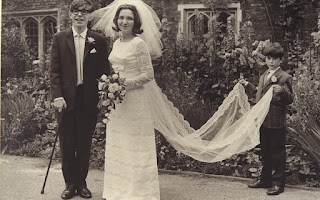
I have chosen to do another neuro note on ALS because the disease is just so sad, but bizarre and complex. I feel like for every question there is answered, another one pops up.  The fact that the muscle groups and body systems slowly start to malfunction and play out, but the mind and processing skills remain unshaken completely baffles researchers and health care providers. This disease traps people in their own body and that is a concept that is hard to understand unless you are forced to endure it. In the movie, The Theory of Everything, famous physicist, cosmologist, and author Steven Hawking, suffers from the handle of the progressive disorder.  Hawking was diagnosed at age 21 and in the movie there are several precursors of the disease before his diagnosis. He knocked over a coffee cup, shows several "clumsy" signs with his feet and awkward placements of his hands, and he has a serious fall resulting in a scan of his brain and the confirmation of his diagnosis. His ...

End ALS

Image
For this neuro note, I watched an ALS patient give a TED Talk with the help of his friends. Hiro Fujita rode a power wheelchair on the stage and wore a shirt that said end ALS. His symptoms started with tingling in the fingers and Hiro thought he was hungover from his rambunctious life style habits. When he went to the doctor, however, he was diagnosed with ALS and as he put it, "Asked to step off the field but thanked for playing the game". As far as he could see, his life was over or at least not far from it. His hands begin to slowly loose function and he began to have multiple falling episodes. He explained one time when his legs gave out in the street but no one would help him because they assumed he was a drug addict. Eventually, when it was time to make the decision on wether or not to get the tracheotomy, Hiro decided to have the procedure done because he felt that he had not contributed to life yet. He wanted to make a difference and speak out for advocacy of the dis...

Walk, Ride, Rodeo

Image
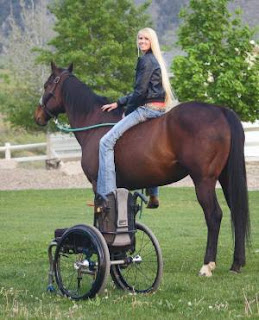
For this neuro note, I watched the movie Walk, Ride, Rodeo. This movie is based on a true story about a 19 year old girl, Amberley, who is an award winning barrel racer in rodeo competitions. Right before she was set to start college and advance her rodeo career, she was involved in a terrible car accident that resulted in her T-12 vertebrae being crushed. Amberley was diagnosed with an incomplete spinal cord injury and lost all function, movement, and sensation in her legs. Of course, as a 19 year old athlete, this was a hard adjustment for her and she faced many obstacles on her journey to learning her new normal. Her attitude in therapy was not the most positive, but, after weeks of improvement she gave a lot of credit to the therapist and began to have a more optimistic approach in her rehab. She battled many wars with herself and had many days where she wanted to give up and even mentioned she wished she would have died in the crash. Her mother said to her, "This chair...

Neuro Note #1

For this assignment, I chose to watch a TED talk on Alzheimer's disease. Alanna Shaikh takes a different approach on the topic than I have ever seen before. After watching her dad deal with the illness for twelve years, she has decided to prepare to get the disease herself. Initially, I thought this was a bizarre way of looking at things and I viewed it as more pessimistic, but then as she continued she changed my mind. It is not that she has given up or accepted her fate that she is doomed to the disease, it is that she will be prepared to fight as long as she can if she contracts it. She kept saying "if the monster wants you, the monster will get you". Even though she is working out and keeping up with her physical health, reading and learning to develop more and more cognitive functioning skills, Alzheimer's does not discriminate and there is no way of 100% preventing the terrible occurrence. In this class, along with all of the other neurological diseases, we wi...

Hierarchy of Mobility Skills

Image
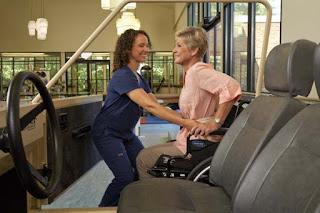
When someone undergoes an experience that requires them to participate in therapy, in most cases they have to regain confidence. Clients have to get comfortable in their abilities to perform their ADLs. Mobility is best defined as the ability to move freely. As a possession that most take for granted, it is not understood just how disabling it may feel to have reduced mobility or it taken from you completely. In the future as an occupational therapist, it will be our job to restore this confidence in our clients and watch them grow and reach their goals. The hierarchy of mobility skills listed in our notes, is set up in the form of a pyramid. At the base of the structure, there is bed mobility and at the very top is community and driving. As your patient builds confidence, they climb up the levels of the pyramid. The order of the steps did not exactly make sense at first, but after deliberation and more review the pieces started to add up. Bed mobility, being the first step, means th...

Assistive Devices

Just like a pair of shoes or clothing, people who need assistive equipment should have the appropriate size and fit for their device. Having crutches, a cane, or walker that is too tall for a client would just be uncomfortable for them. If the height is not right, posture, balance, and stability could all be affected in a negative manner.  However, if the fit is just right, it can help people perform tasks that they could not before and be a very helpful tool. The adjustment of all the following devices are very simple. In order to correctly adjust the height of the cane, you must find the greater trochanter and make sure that the patient is holding the cane on the opposite of the affected lower extremity. Another landmark to look for is the wrist crease or the ulnar styloid with the arms down by the side. When fitting a client for axillary crutches, the crutch length should approximately be as long as the patient's forearm to the tips of the fingers on the opposite side. When st...